

In short: yes, you can buy property in the Riviera Maya as a foreigner. Because the entire Quintana Roo coast lies within the restricted zone, the purchase is made through a bank trust (fideicomiso): a Mexican bank holds legal title and you keep every right to use, rent, sell and pass on the property. Setting it up costs roughly 500 to 2,500 USD depending on the bank, and the whole process usually takes 4 to 8 weeks.
What is the restricted zone and why does the fideicomiso exist?
The restricted zone is the strip extending 100 km (62 miles) along the borders and 50 km (31 miles) from the beaches where foreigners cannot acquire real estate directly. It is set out in Article 27 of the Mexican Constitution and developed by the Foreign Investment Law.
The entire Riviera Maya falls within that strip: from Isla Mujeres in the north to Mahahual in the south, including Cancún, Puerto Morelos, Playa del Carmen, Puerto Aventuras, Tulum, Cozumel and Bacalar.
So that foreigners can invest in this zone, the law created the fideicomiso. Far from being a limitation, it is a regulated mechanism that has worked for more than five decades and gives you the practical rights of an owner, backed by a supervised banking institution.
What is a fideicomiso and who is involved?
A bank trust is a contract under which a Mexican bank receives legal title to the property and manages it solely according to your instructions. It is governed by the General Law of Negotiable Instruments and Credit Operations (Ley General de Títulos y Operaciones de Crédito), and trustee banks are supervised by the National Banking and Securities Commission (CNBV).
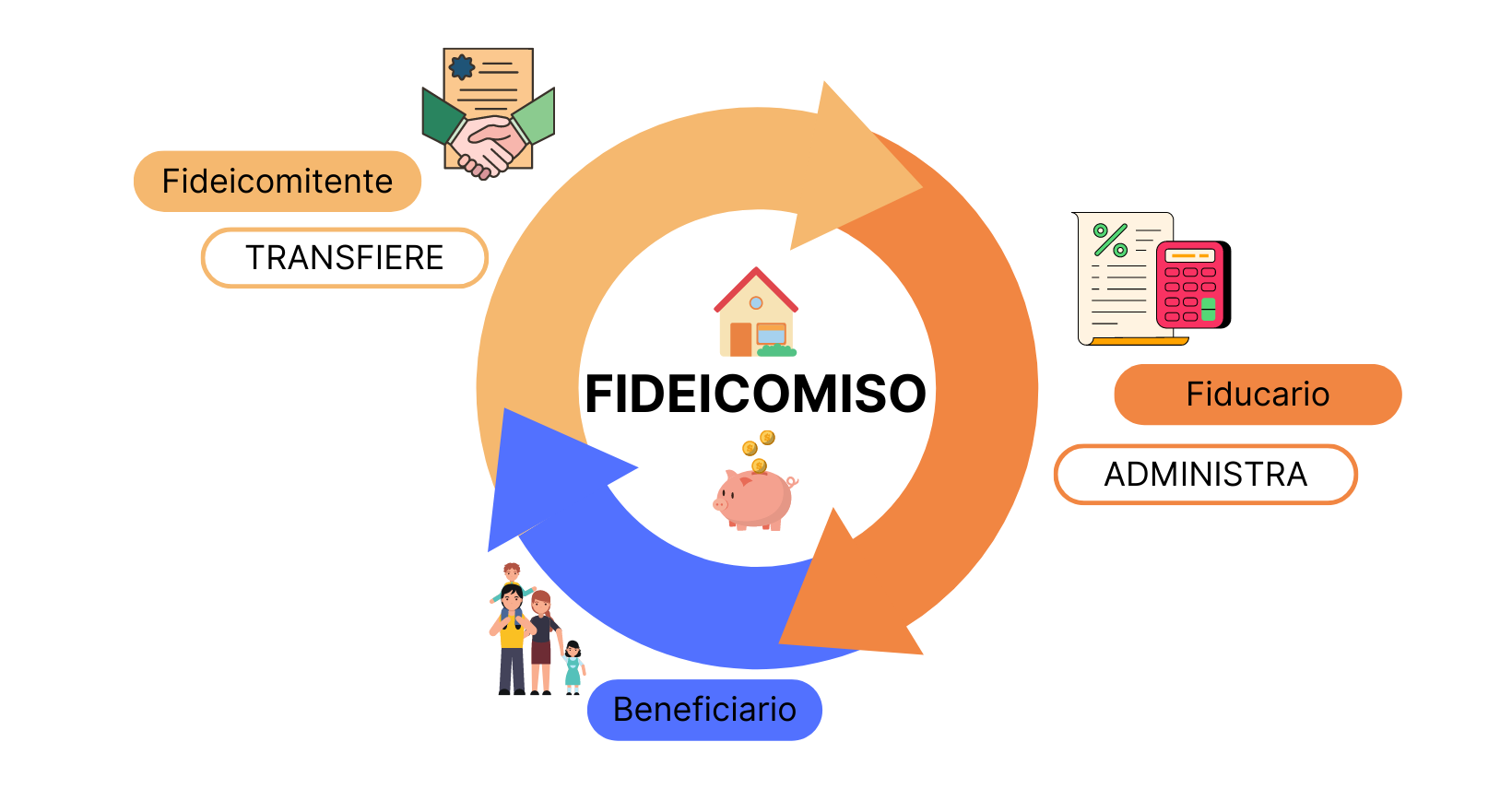
- Settlor (fideicomitente): the seller of the property (an individual, a company or the developer), who contributes the property to the trust.
- Trustee (fiduciario): the Mexican bank (for example BBVA, Banamex or Santander), which holds direct title to the property.
- Primary beneficiary (fideicomisario titular): you, the foreign buyer (individual or company), with the use and enjoyment of the property. It can be one or several people.
- Substitute beneficiary (fideicomisario sustituto): the person who will take your place if you pass away and acquire all rights under the contract.
What can you do with a property held in a fideicomiso?
You can do practically the same as a direct owner: live in it, rent it out (including on Airbnb), lend it, remodel it, sell it or leave it to your heirs. The bank has no decision-making power or financial interest in the property, and it cannot sell or encumber it without your express authorization.
This structure is designed for residential property. If the property is for commercial use, the usual route is a Mexican company (covered below).
There is also no limit on how many trusts you can hold: one for a condo in Playacar, another for a lot in Aldea Zamá and another for a villa in Puerto Aventuras, for example. If you plan to rent, also check how to report vacation rental income.
What are the requirements and how does the process work?
You need a permit from the Ministry of Foreign Affairs (SRE), your passport and personal details: proof of address, proof of employment or income, phone number, occupation and email. The notary, your lawyer and the bank coordinate the rest.
- You choose the property and sign the purchase agreement.
- The notary public arranges the trust with an authorized bank.
- The SRE permit is requested, which usually takes 5 to 15 business days.
- Lawyer and notary coordinate the signing of the deed with the bank, seller and buyer, which takes a minimum of about 20 calendar days.
- The trust is recorded in the Public Property Registry.
In most cases the whole process takes 4 to 8 weeks. Payment must come directly from the account of the person or company that will be the beneficiary. You can follow the full journey in our step-by-step buying guide and learn about the notary's role on the website of the Mexican National College of Notaries.
How much does a fideicomiso cost?
The trust has a one-time setup cost and an annual fee charged by the bank. Figures vary by institution and property value, so it is worth comparing at least two or three banks.
| Item | Approximate range | When it is paid |
|---|---|---|
| Trust setup | 500 to 2,500 USD (higher quotes usually include the first annual fee) | Once, at purchase |
| Annual bank fee | 500 to 1,000 USD per year | Every year |
| Total transaction costs (taxes, fees, legal and notary fees) | 5% to 8% of the property value | At closing |
Some banks charge the fee in Mexican pesos, which can work in your favor if the peso weakens against the dollar. If the property generates rental income, the annual fee can be deducted from that income. For the full breakdown, see the buying costs for foreigners.
How long does a fideicomiso last and how is it renewed?
The contract has a term of 50 years and is renewable. When the term ends, the permit and the corresponding contract are renewed, a simple administrative procedure.
In practice, renewal lets you keep the property for the long term and pass it on to your heirs without losing your rights.
When is the fideicomiso set up if you buy pre-construction?
If you buy pre-construction with a promissory purchase agreement, the trust is set up once the development has its condominium regime, or once the land has been subdivided or platted with its measurements, boundaries and Public Property and Commerce Registry record.
Generally that happens when the building is in the final stages of construction. Until then, your rights are documented in the promissory agreement, so review it carefully. Our pre-construction buying checklist can help.
Can the bank keep your property?
No. The bank acts only as trustee, an administrative role, and the trust is a separate estate from the bank's own assets. Your position as beneficiary is protected by law and does not depend on the institution's financial situation.
In the unusual event that the trustee bank fails, goes into liquidation or is absorbed, the trust is transferred to another institution under CNBV supervision, without affecting your rights to the property. Bank failures are uncommon in Mexico.
How do you sell or pass on a property held in a fideicomiso?
To sell, you have two options. Both involve a notary, a lawyer and the bank, provided you are up to date on annual fees and give the trustee written instructions:
- Assign the trust rights to the new buyer, whether foreign or Mexican. This is the most common and fastest option.
- Terminate the trust so the buyer can set up a new one or, if Mexican, acquire the property directly.
For inheritance, you name substitute beneficiaries from the start and can change them whenever you want. If you pass away, they present the death certificate to the bank and obtain a new deed, with no probate proceedings in Mexico. More details in our guide to property inheritance for foreigners.
Fideicomiso or Mexican company: which suits you?
For most individual buyers, the fideicomiso is simpler, cheaper and just as secure. A Mexican company (S.A. de C.V. or S. de R.L.) makes sense in specific cases.
| Situation | Usual option |
|---|---|
| One or two properties for personal use or vacation rental | Fideicomiso |
| Several properties with centralized management | Mexican company |
| Significant rental income with deductible corporate expenses | Mexican company |
| Business partners who need a governance structure | Mexican company |
| Commercial-use property or property outside the restricted zone | Mexican company |
We compare them in depth in fideicomiso vs. Mexican corporation.
Do you need to be in Mexico to sign?
It is not required. Your lawyer keeps you updated on progress and tells you the signing date. If you cannot travel, you can grant them a power of attorney, issued in Mexico or abroad, to represent you throughout the process.
We explain how in our guide to buying with a power of attorney without traveling.
Frequently asked questions
Does a Mexican citizen also need a fideicomiso?
No. Mexicans can own property directly in the restricted zone. The fideicomiso is for foreign buyers.
What is the difference between a fideicomiso, a public deed and a property title?
In practice they are the same document: the public deed is the trust contract that sets the terms and conditions, and it is what you use to prove your trust rights.
Can you change trustee banks?
Yes. You can replace the trustee at any time, although the change involves notary and registry costs.
Can you get a mortgage with a fideicomiso?
Yes. Some Mexican and international banks and specialized lenders offer financing with the trust as collateral. Rates tend to be higher than in the United States or Canada (roughly 8% to 12% per year), which is why many buyers pay cash. Review the financing options for foreigners.
Can a foreign LLC or company buy?
Yes, under certain conditions and with additional documentation. A specialized lawyer can structure the transaction to be legally and tax efficient for your situation.
At L'Agence we have guided international buyers since 2015 through the entire process, including the trust setup. Contact us and we will advise you on your case.
You may also be interested in: The Evolution of Foreign Investment in Mexican Real Estate: From Openness to the Fideicomiso and Safety in the Riviera Maya: What You Really Need to Know as a Foreign Buyer.
Why L'Agence
Over 10 years guiding buyers from around the world in the Riviera Maya, from search to closing. Trilingual team and AMPI members.
+200 listed properties · 4.9★ on Google · +30 properties under management
Talk to an advisorKeep exploring