

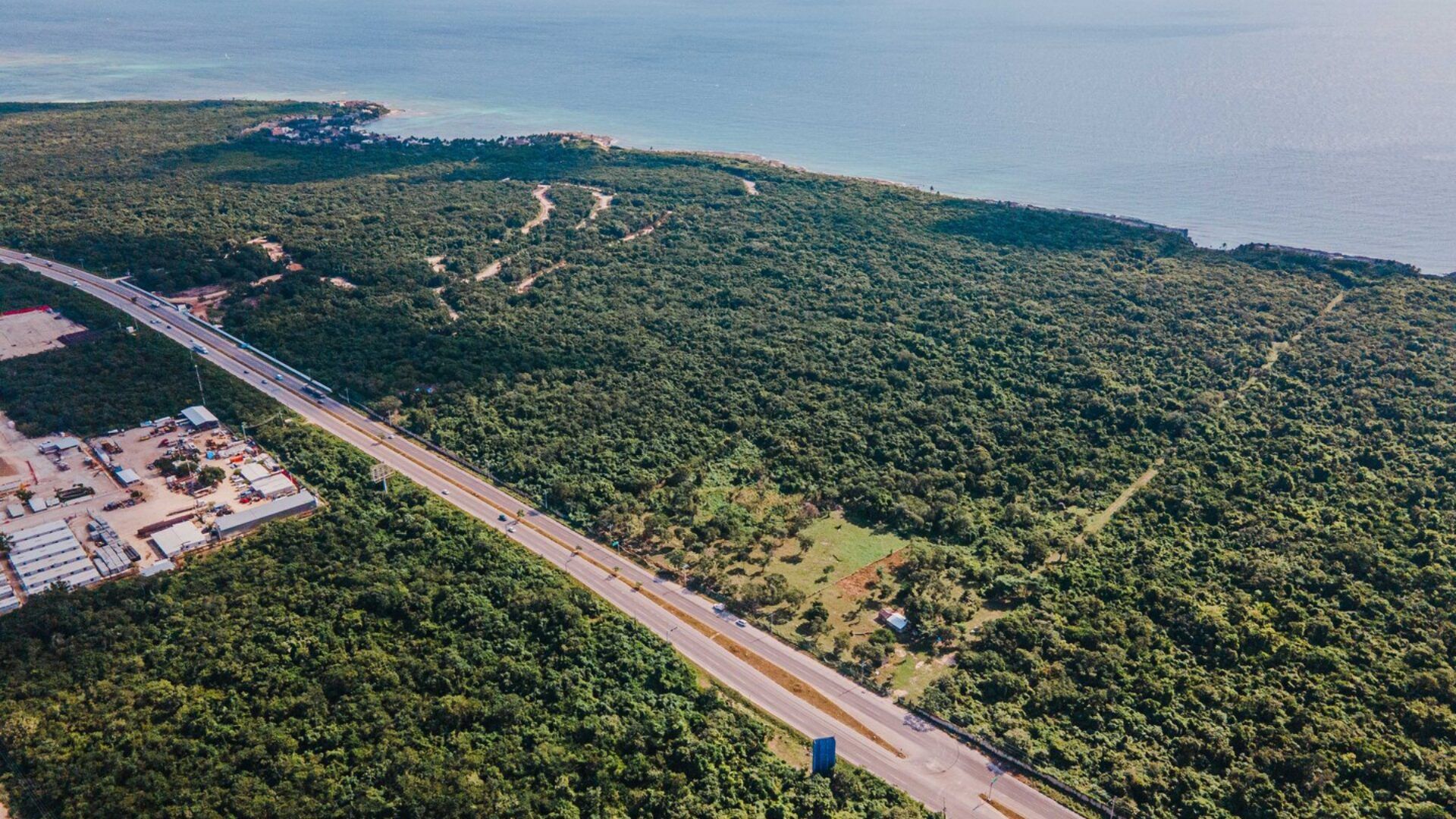
In short: This is a 17.5-hectare plot with 280 meters of beachfront between Playa del Carmen and Puerto Aventuras, with direct access from federal highway 307. It includes three archaeological ruins registered with INAH, a cenote and approved density for up to 180 hotel rooms or 216 residences. Its list price is USD 21,000,000.
What does this beachfront land offer?
It is one of the few large beachfront parcels left in the heart of the Riviera Maya, designed for a luxury tourism or hotel development. These are its main features, according to the property listing:
| Feature | Detail |
|---|---|
| Size | 17.5 hectares (about 175,000 m²) |
| Beachfront | 280 meters |
| Heritage | 3 archaeological ruins registered with INAH |
| Nature | A cenote on the property |
| Approved density | Up to 180 rooms or 216 residences |
| Access | Direct from federal highway 307 |
| Location | Between Playa del Carmen and Puerto Aventuras |
| List price | USD 21,000,000 |
You can see all the details and the gallery on the 17.5-hectare beachfront land listing.
Where is it located and what is nearby?
The land sits on the coastal corridor between Playa del Carmen and Puerto Aventuras, one of the most established stretches of the Mexican Caribbean. Direct access from federal highway 307, the road that runs along the entire coast from Cancún to Tulum, simplifies construction logistics and guest arrivals.
To the north is Playa del Carmen, with its services, restaurants and urban life; to the south, Puerto Aventuras, with its marina and golf course, and further on Akumal and Tulum. This corridor is home to theme parks, cenotes and large hotels that attract visitors all year round.
For air connections, the area lies between two international airports: Cancún, operated by ASUR, to the north, and Tulum International Airport to the south.
What can be developed on 17.5 hectares?
The approved density allows two main paths: a hotel project of up to 180 rooms or a residential development of up to 216 residences. With this much land, either one can be planned with low site coverage, large green areas and a direct relationship with the beach.
The combination of beach, cenote and Mayan ruins lends itself to an eco-luxury and culture concept: a destination that blends history, nature and luxury rather than a conventional development. It is the kind of product sought by the high-spending travelers who come to the Riviera Maya; for official occupancy and arrival figures you can check DATATUR.
For reference, the list price is equivalent to about USD 120 per square meter of land, based on the total area.
What does having archaeological ruins and a cenote on the property involve?
It is a differentiating asset and also a responsibility. The three ruins are registered with INAH (the National Institute of Anthropology and History), the federal authority that protects archaeological heritage; any project must integrate them and respect the conditions that institution sets.
Handled well, they become the narrative heart of the project: interpretive trails, contemplative spaces or cultural experiences for guests and residents. The cenote, for its part, adds exclusivity and a connection with nature, and its conservation should be part of the design from the start.
Can a foreign investor buy it?
Yes, with the right structure. The land is in the restricted zone (the 50 km coastal strip), where Article 27 of the Constitution and the Foreign Investment Law set out how foreigners can acquire property: through a bank trust (fideicomiso) or through a Mexican company, which for non-residential purposes must notify the Ministry of Foreign Affairs (SRE).
For a hotel or mixed-use project, the choice of structure has tax and operational consequences, so it is best defined with your lawyer and accountant before signing. We explain the details in our land investment guide for foreigners.
What should you check before buying land like this?
In a transaction of this size, legal and technical verification is as important as location. Before committing capital, check at least:
- The title deed and its registration in the Public Property Registry, free of liens.
- The documents supporting the approved density (land use and current permits).
- The environmental requirements that apply to a coastal development with a cenote.
- The conditions set by INAH for the archaeological ruins.
- The status of the federal maritime-terrestrial zone along the beach.
Ideally, carry out full due diligence with an independent lawyer before any payment.
Who is this opportunity for?
For developers, hotel groups, investment funds or family offices looking for a large, scarce beachfront parcel in the Riviera Maya. It is not a purchase for an individual investor seeking a vacation rental, but the foundation of a long-term visionary project.
Frequently asked questions
How much beachfront does the land have?
It has 280 meters of beachfront, on a total area of 17.5 hectares.
How many rooms or residences can be built?
The approved density is up to 180 hotel rooms or up to 216 residences.
What is the price?
The list price is USD 21,000,000. To receive detailed information and documentation, contact our team.
How do you access the land?
It has direct access from federal highway 307, between Playa del Carmen and Puerto Aventuras.
Want to develop your project in the Riviera Maya? Contact us and our trilingual team will guide you every step of the way.
You may also be interested in: Beachfront Property Appreciation on the Riviera Maya: 5-Year Data and Beachfront Properties in Quintana Roo: Complete Cost Guide.
Why L'Agence
Over 10 years guiding buyers from around the world in the Riviera Maya, from search to closing. Trilingual team and AMPI members.
+220 listed properties · 4.9★ on Google · +30 properties under management
Talk to an advisorKeep exploring