

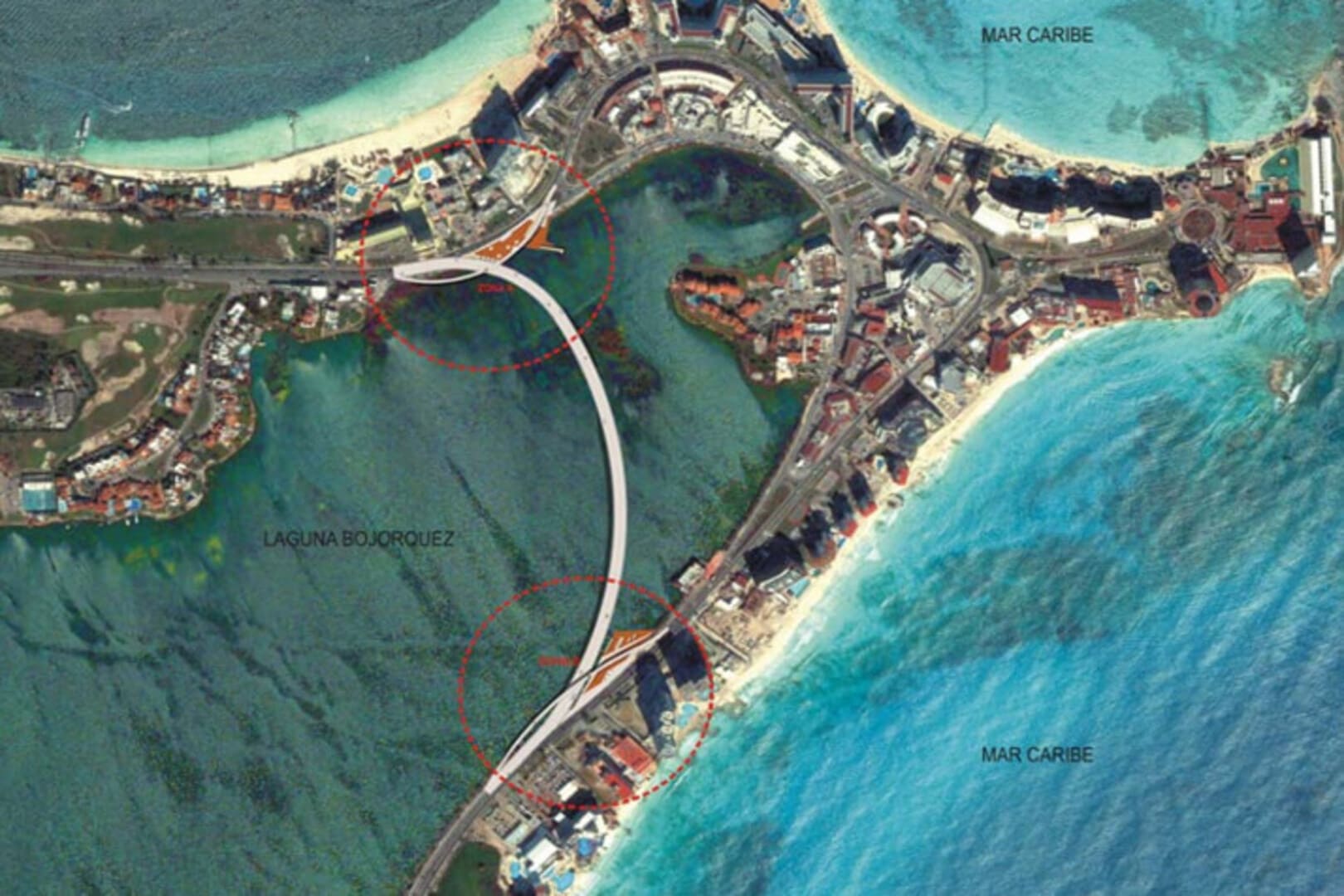
In short: the Nichupté Lagoon Vehicular Bridge is an elevated viaduct that crosses the lagoon and links mainland Cancún with the Hotel Zone, with no need to go around it via Kukulcán Boulevard. Construction began in 2022 and its opening was scheduled for 2026. For the real estate market, its main effect is bringing the southern Hotel Zone closer, in travel time, to the rest of the city and the airport, which according to market estimates is already reflected in prices there.
What is the Nichupté Bridge and what does it connect?
It is an elevated road viaduct of around 7.6 kilometers built over the Nichupté Lagoon. It connects mainland Cancún with the southern stretch of the Hotel Zone, near kilometer 14 of Kukulcán Boulevard, where five-star hotels and residential developments are concentrated.
Until now, the only way to reach the Hotel Zone was Kukulcán Boulevard, a corridor that could be jammed for hours in high season. The bridge removes the need to go around the lagoon and considerably shortens trips for tourists and residents.

It is Cancún's most significant road project in decades and the most anticipated by the tourism sector, the economic engine of the city and of all of Cancún and its metropolitan area.
When was the bridge scheduled to open?
Construction started in 2022. In 2024 the project was expected to be completed between late 2024 and 2025, but the schedule was extended and the opening was scheduled for 2026.
The project faced major technical challenges due to lagoon conditions and the environmental standards required for a body of water of this kind. If you are evaluating a purchase that depends on the bridge, we recommend confirming its operating status and current conditions of use through the official channels of the Government of Quintana Roo.
How much time does the bridge save?
According to published estimates, the trip between the airport and kilometer 14 of Kukulcán goes from 35-45 minutes in traffic to about 12-15 minutes. For a destination that lives on international tourism, this is a first-order change.
The benefit is not only for those arriving by plane at Cancún International Airport (ASUR). Residents also save time getting to work, school or appointments, and easing congestion on Kukulcán Boulevard improves road safety on one of the city's busiest roads.
Less time in traffic means a better quality of life for those who live in Cancún and a better experience for those who visit, especially in high season.
Which areas of Cancún benefit the most?
The southern Hotel Zone (km 14-23) is the big winner. This strip, which includes Nizuc, Punta Nizuc and Gran Caribe, was perceived as "far from the airport," and that factor weighed on its relative prices. With the bridge, that disadvantage shrinks.
| Area | Main effect | Estimated price impact |
|---|---|---|
| Southern Hotel Zone (km 14-23) | Direct access from the city and the airport | +11% in 2025-2026 (vs. +6% Hotel Zone average); additional potential of 8-15% over two years |
| Hotel Zone km 8-12 | Smaller time savings, but less traffic on Kukulcán | Indirect benefit |
| Puerto Cancún | Overall boulevard decongestion | Trips up to 20% faster to the Hotel Zone or the airport |
| Downtown Cancún | Less congested alternative roads | +2-4% estimated |
All these figures are market estimates, not official data. To compare neighborhoods in more detail, see our guide to the best areas of Cancún to live and invest.
How does the bridge affect property values?
By improving connectivity, the bridge increases demand for properties in nearby areas and, with it, their value. Properties close to the bridge attract both Mexican and international buyers.
Airport-to-hotel transfer time is a factor that large tour operators consider when evaluating a destination. With a 12-15 minute ride, the southern Hotel Zone can compete on equal terms with kilometers 8-10, historically the most sought after for their proximity to the airport.
That greater accessibility also makes Cancún more attractive to developers and commercial projects, which usually translates into more supply, better services and more jobs. Tourism, measured by the official statistics of DATATUR, remains the foundation of that demand. If you want to see concrete options, discover Bay View Grand, luxury residences in the Hotel Zone.
Is it still a good time to buy in the southern Hotel Zone?
According to available estimates, the full impact of the bridge would take 3 to 5 years to be completely reflected in prices. Those buying in 2026 can still capture part of that effect before the market fully prices it in.
The areas with the greatest additional appreciation potential are kilometers 16-20 of Kukulcán, Punta Nizuc and the land still available at the southern end of the Hotel Zone.
Even so, no projection is a guarantee: it is wise to review each development, its legal status and its real rental potential. We can help you with that analysis; also check out the emerging areas of Cancún and the overview of the infrastructure transforming the Riviera Maya.
What was done to protect the lagoon?
The project was designed with sustainability and the protection of the lagoon environment in mind. According to project information, sustainable materials and construction techniques were used, along with drainage systems to prevent water pollution and ecological corridors for local wildlife.
The bridge was also designed to high road-safety standards and with hurricane-resistant structures, an essential requirement in the Mexican Caribbean.
Why will the bridge become a Cancún icon?
Beyond its road function, the crossing offers panoramic views of the lagoon, its natural areas and Cancún's skyline, by day and by night. It is an attraction for photographers and nature lovers.
For residents it represents the growth and modernization of their city; for visitors, one more example of what Cancún has to offer as a world-class destination.

Frequently asked questions
Does the Nichupté Bridge have a toll?
Yes, the bridge was planned with a toll system. The estimated cost for private vehicles was about MXN 50-80 per trip; check the current rate before crossing.
How long did it take to build?
Work began in 2022. It was initially expected to be completed between late 2024 and 2025, and its opening was later scheduled for 2026, meaning roughly four years of construction.
Does the bridge have a bike lane or public transportation?
According to available information, the design is geared toward private vehicles and passenger transport, with no bike lane on its main section. Possible alternative transportation additions in future phases have been discussed.
Which part of the Hotel Zone benefits the most?
The southern zone (km 14-23), followed by developments in Punta Nizuc and Gran Caribe. Kilometers 8-12 gain less in travel time, but benefit from the boulevard's decongestion.
Can you advise me on investing near the bridge?
Yes. At L'Agence we have more than 10 years in the Riviera Maya and a trilingual team that supports you throughout the process. Write to us and we will show you the options that best fit your goal.
You may also be interested in: Cancun Financial and Technology District: What $1.3 Billion USD Means for Real Estate and Nearshoring and Real Estate: How Industrial Relocation Is Driving the Cancún and Riviera Maya Market.
Why L'Agence
Over 10 years guiding buyers from around the world in the Riviera Maya, from search to closing. Trilingual team and AMPI members.
+200 listed properties · 4.9★ on Google · +30 properties under management
Talk to an advisorKeep exploring