

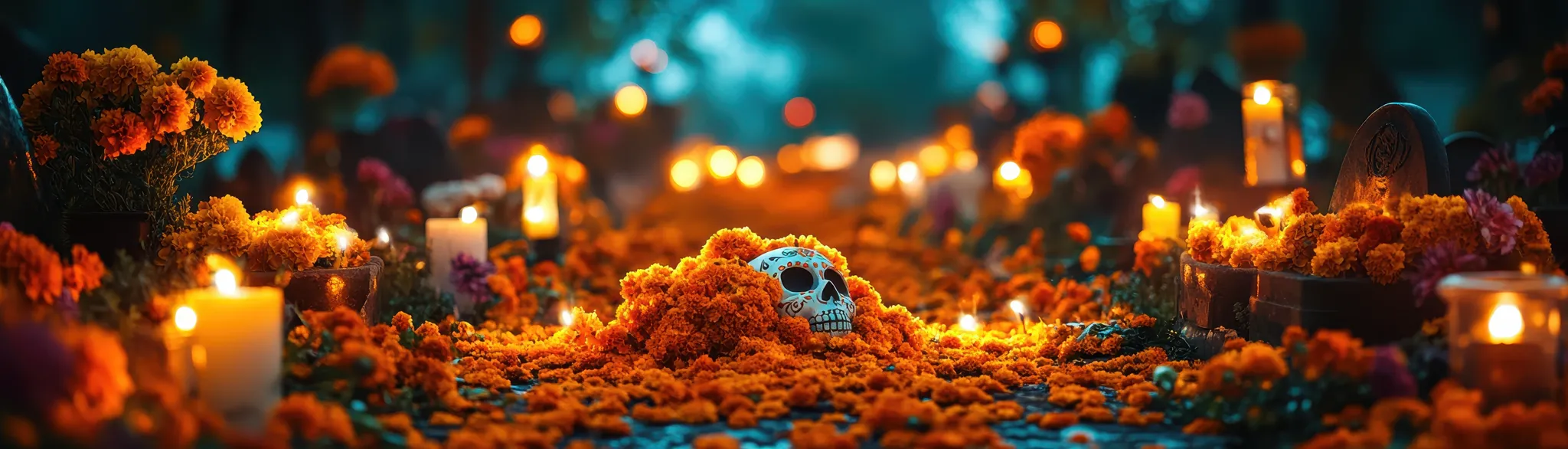
Tulum has something you won't find anywhere else in the Riviera Maya. Its Mayan ruins rise from a cliff overlooking the Caribbean, and on the nights of the Day of the Dead, when hundreds of candles flicker in the wind among the ancient stones, the line between past and present disappears entirely. This isn't a metaphor. It's exactly what you feel standing among those structures as the sea crashes below and the sky fills with stars.
Day of the Dead in Tulum isn't a show staged for visitors. It's a celebration born from the blending of the Mayan tradition of Hanal Pixán with the mestizo customs brought by families from other Mexican states. The result is something unique, profound, and completely different from what you'll experience in any other city.
The Illuminated Ruins: A Scene from Another Century
On the nights of November 1 and 2, the Tulum archaeological site takes on a different life. Although nighttime access isn't always guaranteed as an official event, in recent years the local community and authorities have organized special illuminations with candles and torches that transform the site into something straight out of a painting.
El Castillo, the main structure crowning the cliff, stands silhouetted against a dark sky while below, phosphorescent waves crash onto the beach. The altars set up on the esplanade in front of the ruins hold offerings that blend Mayan and Catholic elements: mukbil pollo (a Mayan chicken tamale baked underground) beside pan de muerto, balché (a ceremonial Mayan drink) beside hot chocolate, cempasúchil marigolds beside palm fronds.
It doesn't matter how many times you've visited the ruins by day. At night, with the candles lit and the sound of the conch shell calling to the souls, it's another experience altogether.
Cenote Ceremonies: The Portal to Xibalbá
The Maya considered cenotes to be gateways to Xibalbá, the underworld where souls completed their journey after death. That belief never disappeared. In and around Tulum, several communities keep alive the tradition of holding Hanal Pixán ceremonies inside the cenotes during the first days of November.
A Mayan priest leads the ritual in Yucatec Maya as families place offerings on the water: floating candles, flowers, food. The echo inside the cavern amplifies every word of the prayer, and the reflection of the flames on the water's surface creates an image that stays etched in your memory. This isn't adventure tourism. It's an act of faith that has been repeated for centuries.
Cenotes such as Gran Cenote, Cenote Calavera, and other lesser-known ones in the jungle between Tulum and Cobá serve as the setting for these ceremonies. The experience is open to anyone who approaches with genuine respect.
Tulum Pueblo: Altars on Every Corner
While the Hotel Zone keeps a more cosmopolitan profile, Tulum Centro reveals the most authentic side of the celebration. The town's streets fill with altars set up by families, shops, and schools. The central park becomes a gathering place where neighbors compete for the best community altar, food is shared, and live music plays until dawn.
Local markets offer everything you need to build an offering: fresh cempasúchil, copal, pan de muerto, sugar skulls with names written across their foreheads, candles of every size. Families living in Región 15 and Aldea Zamá take an active part, bringing Mexican and foreign residents together in a celebration that makes no distinction between passports.
The town's restaurants prepare special menus featuring seasonal dishes: relleno negro, papadzules, sopa de lima, and the essential mukbil pollo. These aren't fusion plates or gourmet reinterpretations. They're recipes that Yucatecan grandmothers have prepared the same way for generations.
Hanal Pixán: The Mayan Version of the Day of the Dead
In Tulum, Hanal Pixán carries special weight because the Mayan presence in the region was never interrupted. The surrounding communities still practice the traditions just as they were handed down from generation to generation. The three days of the celebration follow a precise order: on October 31 the souls of children return, on November 1 those of adults, and on the 2nd they all depart together in a final ceremony.
Offering tables in Mayan homes stand out for their hand-embroidered tablecloths, gourds filled with new atole, tamales buried in a pib (an earth oven), and copal incense that purifies the space. It's a direct window into a worldview where death is not an ending but a passage.
Living It from Your Home in Tulum
Being a Tulum resident during Day of the Dead means walking from your condo in Aldea Zamá to the town park and finding your neighbors putting together the community altar. It means hearing the conch shell sound at dusk and knowing exactly what it means. It means your children growing up understanding that death is something to honor, not to hide.
At L'Agence, we have properties in Tulum's Hotel Zone, Región 15, Tulum Centro, and Aldea Zamá. Finding your place in this town means finding a place within a tradition that has been alive for thousands of years. Talk to us, and we'll show you the options that bring you closer to all of this.
You may also be interested in: Day of the Dead in the Riviera Maya: Experience the Tradition from Your Caribbean Home and Wellness Real Estate in the Riviera Maya: Developments with Integrated Spa, Yoga and Wellbeing.
Why L'Agence
Over 10 years guiding buyers from around the world in the Riviera Maya, from search to closing. Trilingual team and AMPI members.
+210 listed properties · 4.9★ on Google · +30 properties under management
Talk to an advisor